
So, how many bike miles equal running? Generally, it takes about 3 to 4 miles of cycling to equal 1 mile of running for a similar cardiovascular benefit, but this is a broad estimate. The real answer depends heavily on cycling intensity, your personal running cardio capacity, and the specific exercise conversion you’re aiming for. This guide will help you decipher the relationship between cycling and running for effective fitness comparison and endurance training.
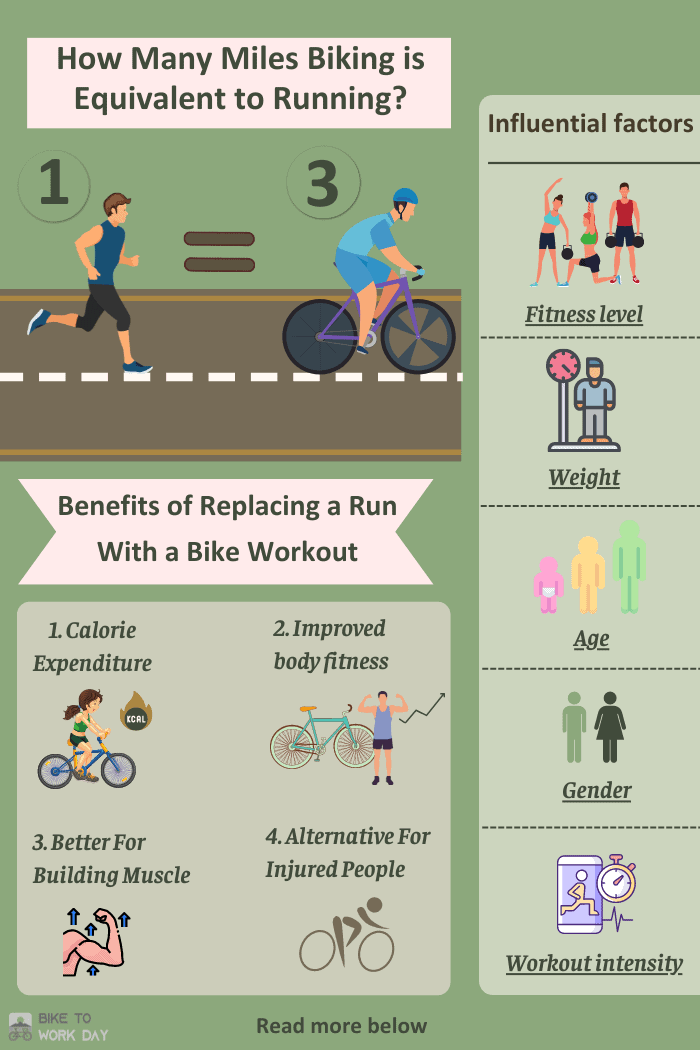
Image Source: biketoworkday.us
Deciphering the Equivalence: Why the Numbers Vary
Many people wonder about the direct comparison between cycling and running. It’s not a simple one-to-one ratio because the two activities use different muscles and at varying intensities. Your cardiovascular fitness is the key metric, and achieving a similar level of aerobic stimulus can be done through both.
The Role of Intensity
The most crucial factor in exercise conversion is workout intensity. A leisurely bike ride will not burn the same number of calories or provide the same cardiovascular challenge as a high-intensity interval training (HIIT) run.
Cycling Intensity Levels
- Low Intensity (Zone 1-2): This is a relaxed pace, where you can easily hold a conversation. For example, a 10-mile easy bike ride might be equivalent to a 2-mile slow jog in terms of effort, but less so in terms of calorie burn or cardiovascular conditioning.
- Moderate Intensity (Zone 3): You can talk, but in shorter sentences. A 10-mile ride at this pace could be roughly equivalent to 2.5-3 miles of running at a similar perceived exertion.
- High Intensity (Zone 4-5): This is where you’re working hard, breathing heavily, and can barely speak. A 10-mile fast cycling session, perhaps with hills or sprints, could be closer to 3.5-4 miles of challenging running.
Running Intensity Levels
Running naturally engages more muscle groups and requires more effort to propel your body weight forward.
- Easy Pace: Conversational, can maintain for a long time.
- Moderate Pace: You can speak in short phrases.
- Hard Pace: Difficult to speak, breathing heavily.
Calorie Burn: A Key Comparison Point
While not the only measure of cardiovascular fitness, calorie burn is often a primary concern. Cycling, especially at higher intensities, can burn a significant number of calories. However, pound for pound, running often leads to a higher calorie burn per mile due to the increased muscle engagement and the work done against gravity.
Example:
- A 150-pound person cycling at 15 mph for 30 minutes burns approximately 350 calories.
- A 150-pound person running at 6 mph for 30 minutes burns approximately 400 calories.
This suggests that to achieve a similar calorie burn, you might need to cycle for a longer duration or at a higher intensity than you run. This is where the mileage conversion gets tricky.
Aerobic Equivalent: Fathoming the Cardiovascular Benefit
The concept of aerobic equivalent looks at how much each activity taxes your heart and lungs. Both cycling and running are excellent for building cardiovascular fitness. However, the impact and muscle recruitment differ.
- Running: Is a weight-bearing exercise, meaning your body is supporting its own weight. This recruits more muscles, especially in your legs and core, and provides a greater impact, which can be beneficial for bone density but also carries a higher risk of injury.
- Cycling: Is a non-weight-bearing exercise. It’s lower impact, making it easier on the joints. It primarily targets the quadriceps, hamstrings, and glutes. To get a similar cardiovascular fitness boost as running, you often need to increase the cycling intensity or duration.
Factors Influencing the Conversion Ratio
The general rule of thumb (3-4 miles cycling to 1 mile running) is a starting point. Your personal physiology and training goals will dictate the precise exercise conversion.
Personal Fitness Level
Your current cardiovascular fitness plays a huge role.
- Beginners: Someone new to exercise might find that a few miles of cycling offer a substantial workout, perhaps equivalent to a mile or two of running if they are just starting out and running slowly.
- Experienced Athletes: A seasoned runner might need to cycle for much longer or at a much higher intensity to feel a comparable training stimulus. For example, an experienced runner training for a marathon might consider 10 miles of moderate cycling to be equivalent to 3-4 miles of easy running, while a very hard cycling interval session might rival a shorter, faster run.
Terrain and Resistance
The environment where you exercise matters immensely.
- Cycling:
- Flat Terrain: Easier effort, requires longer distances for similar aerobic equivalent.
- Hilly Terrain: Significantly increases cycling intensity, making shorter distances more comparable to running.
- Wind Resistance: Riding against a strong headwind boosts workout intensity.
- Running:
- Flat Terrain: Consistent effort.
- Hilly Terrain: Increases workout intensity and muscle engagement.
- Trail Running: Can involve uneven surfaces, requiring more balance and core strength.
Type of Training
The specific goals of your endurance training will influence the conversion.
- Building Aerobic Base: For building a broad aerobic base, longer, steadier-state efforts on the bike might be equivalent to longer, slower runs. Here, the ratio might be closer to 4:1 or even 5:1 miles of cycling to running.
- Improving Speed and VO2 Max: For high-intensity interval training (HIIT), the conversion is much tighter. Short, hard bursts on the bike can be very similar to short, hard sprints while running. A 1:1 or 2:1 ratio might be more appropriate for these specific intervals, focusing on training zones.
Comparing Training Zones
Training zones are crucial for effective endurance training. They represent different heart rate or power output levels.
| Training Zone | Perceived Exertion | Heart Rate % | Cycling Focus | Running Focus | Approximate Cycling:Running Mile Ratio (for similar effort) |
|---|---|---|---|---|---|
| Zone 1 (Active Recovery) | Very Light | 50-60% | Very easy spinning, recovering from hard efforts | Very slow walk or jog | N/A (focus is on recovery) |
| Zone 2 (Endurance) | Light | 60-70% | Steady pace, can hold a conversation easily | Easy conversational pace | 4:1 to 5:1 |
| Zone 3 (Tempo) | Moderate | 70-80% | Brisk pace, can talk in short sentences | Comfortably hard, can speak in short phrases | 3:1 to 4:1 |
| Zone 4 (Threshold) | Hard | 80-90% | Pushing at lactate threshold, can speak few words | Hard effort, can barely speak | 2:1 to 3:1 |
| Zone 5 (VO2 Max) | Very Hard | 90-100% | All-out sprints, very short intervals | All-out sprints, very short intervals | 1:1 to 2:1 |
Note: These ratios are approximate and highly variable. The goal is to match the physiological stress and cardiovascular stimulus, not just the distance.
Equipment and Technique
The type of bike and your pedaling technique can also influence the effort.
- Road Bike vs. Mountain Bike: A sleek road bike is more efficient than a mountain bike on paved surfaces.
- Pedaling Efficiency: Smooth, consistent pedaling on a bike is more efficient than the stop-start nature of running if not executed well.
Benefits of Cross-Training: Cycling for Runners and Vice Versa
Many athletes incorporate both cycling and running into their training routines for various benefits.
Cycling for Runners
- Reduced Impact: Cycling allows runners to maintain cardiovascular fitness and endurance training without the constant pounding on their joints. This is excellent for active recovery or when dealing with injuries.
- Leg Strength: Cycling can build strength in the quadriceps and hamstrings, which are also crucial for running.
- Mental Variety: Breaking up the monotony of running with cycling can prevent burnout and keep training enjoyable.
Running for Cyclists
- Weight-Bearing Benefits: Running helps improve bone density, which cycling does not significantly contribute to.
- Full Body Engagement: Running engages more of the core and upper body for stability, improving overall athleticism.
- Gait Mechanics: Running reinforces proper running form and efficiency.
Calculating Your Personal Aerobic Equivalent
To get a more personalized exercise conversion, consider these methods:
1. Perceived Exertion (RPE)
This is the most subjective but often the most practical method. Use a scale of 1 to 10, where 1 is resting and 10 is maximal effort.
- If a 5-mile run feels like an “8” on your RPE scale, try cycling until it also feels like an “8.” Note the distance and time. You’ll likely find you cycle further at a faster pace to achieve that same RPE.
- This method helps you calibrate the workout intensity across both activities.
2. Heart Rate Monitoring
Using a heart rate monitor is a more objective way to compare cardiovascular fitness efforts.
- Track your average heart rate during a typical run.
- Then, go for a bike ride and aim to keep your average heart rate in the same range.
- Compare the distances and durations. If you maintain a similar heart rate for 3 miles of running and 12 miles of cycling, your personal ratio is 4:1 for that intensity level.
- This approach directly compares training zones.
3. Power Meters (Cycling Specific)
For serious cyclists, power meters provide the most precise measure of cycling intensity. Comparing your Functional Threshold Power (FTP) or average watts during a cycling session to your VO2 max or pace during a run can give a quantifiable fitness comparison. However, direct comparisons to running power are still an evolving science.
Common Scenarios and Conversions
Let’s look at some practical scenarios for exercise conversion.
Scenario 1: Recovering from a Long Run
Goal: Maintain cardiovascular fitness without high impact.
Approach: A 10-mile easy run might take 1.5 hours. To get a similar cardiovascular benefit with lower impact, you could aim for:
* 25-30 miles of easy to moderate cycling (Zone 2-3). This would also provide a good calorie burn.
Scenario 2: Cross-Training for a Marathon
Goal: Build endurance and leg strength while reducing running volume.
Approach: If you typically run 40 miles per week, you might swap 10 of those miles for cycling.
* Replace 10 miles of easy running with 30-40 miles of moderate cycling. This helps maintain endurance training without the repetitive stress of 10 more miles of running.
Scenario 3: High-Intensity Interval Training (HIIT)
Goal: Improve speed and cardiovascular fitness through short, intense efforts.
Approach: A running interval session might be: 8 x 400 meters at your 5k pace with equal recovery.
* Cycling Equivalent: 8 x 1 minute of high-intensity pedaling (Zone 5 effort, similar to what you’d do on a steep climb or sprint) with 1 minute of easy spinning recovery. The distance covered cycling might be more than the running distance, but the physiological stress is comparable. The workout intensity is the key here.
Frequently Asked Questions (FAQ)
Q1: Can cycling replace running entirely for marathon training?
A1: While cycling is excellent for building cardiovascular fitness and endurance training, it’s generally not recommended to replace running entirely if your goal is to run a marathon. Running specifically trains the muscles, biomechanics, and impact resilience needed for running. However, cycling can be a very effective cross-training tool to supplement running, especially for recovery or injury prevention.
Q2: Is a mile on a bike the same as a mile on foot?
A2: No, not in terms of physiological effort or calorie burn. A mile on foot is generally more demanding than a mile on a bike due to the weight-bearing nature of running and the involvement of more muscle groups. The exercise conversion depends heavily on speed and cycling intensity.
Q3: How can I estimate my personal bike-to-run conversion?
A3: The best way is to use heart rate monitoring or perceived exertion. Go for a run and note your heart rate or how hard it felt. Then, go for a bike ride aiming for the same heart rate or perceived exertion level and see how far you travel in the same amount of time. This will give you a personalized fitness comparison.
Q4: Which activity is better for weight loss, cycling or running?
A4: Both are excellent for weight loss when combined with a healthy diet. Running often burns more calories per mile, but cycling allows for longer duration workouts without the impact, which can lead to a higher calorie burn overall for some individuals. Workout intensity and duration are key factors for both.
Q5: Does cycling help improve running performance?
A5: Yes, especially when used as cross-training. It can improve your cardiovascular fitness, build leg strength (particularly in the quads and glutes), and allow for higher training volume with less risk of overuse injuries. This is crucial for effective endurance training.
In conclusion, while there’s no single magic number for how many bike miles equal running, by considering cycling intensity, running cardio demands, training zones, and your personal fitness comparison goals, you can effectively integrate both activities for optimal health and performance. Whether you’re aiming for a similar aerobic equivalent, maximizing calorie burn, or simply enjoying diverse endurance training, this guide provides the framework to make informed decisions about your workouts.